Showing posts with label #PowerAutomate. Show all posts

Monday, November 28, 2022

What's New in Power Platform - Process Mining

 This is a continuation of my blog series - What's new in Power Platform for the 2022 Release 2. This time the focus is on Process Mining using the Process Advisor. I will discuss here the need for a business process review and how a tool like process advisor can be useful for the organization. There are some paradigms to reflect upon,

"That's how we have always done it"

Organizations have been running business processes for ages on their ERP / CRM platform of choice. The processes may get modified over time and there may be "process debt" which is some old process that is still leftover in place because that was the way the system was set-up. In fact I have asked many clients why they do it in a certain way and the most common answer was "that's how we have always done it here!!"

"We are special" 

Another common answer to the question is "we are special" or "our business is unique". Every client is unique in the way they want to operate their business processes and that can create an ego issue when recommending solutions. I have worked with Clients who have changed their Systems three times but they refused to modify their business process. It is always the systems fault!!

"You cannot improve what you cannot measure"

I normally look for quantifiable data to prove to the client the benefits of a process change. When I ask the Client for any measurement on their business process KPI's they are looking at me as if I am from another planet. What's the point of implementing a system whose performance you cannot measure? How do you ensure the process is working or not? How do you plan to improve??

 That is where the Process Mining can help. It may be time to re-evaluate your current CRM / ERP processes. This will help in -

1. Setting a baseline - How are we doing today? How fast do we complete a Customer support case? What is our Lead to Opportunity conversion ratio?

2. Identify process bottlenecks - What is the longest stage / step in providing a Customer quote? Where does the Case gets stuck the most? How many variants of the process are there?

3. Automate - Identify what can be automated? Provide a business case for automation? How much can we decrease the Call Center agent time by automating certain steps? Do we really need to wait for an approval for all Cases? 

4. Re-evaluate your process - Is it required? obsolete? What are the competitors doing? What can we improve? Are we in compliance?

 Microsoft has recently announced the public preview of the Process Mining capabilities with Minit and Power Automate Process Advisor. 
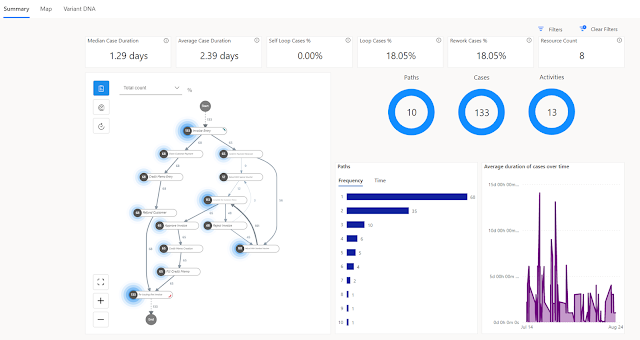
Process Mining - map and dashboard

Some of the new capabilities added to the Process Advisor are detailed here -  https://learn.microsoft.com/en-us/power-automate/process-mining-overview

Highlights -

  • Improved web experience 
  • New Minit Desktop App for deeper analytics 
  • Customizable reporting using Power BI and new pre-built templates

In order to get all the benefits of Process Mining you may require multiple licenses that includes - Power Automate per user, Power BI premium, Microsoft Dataverse etc. If you already have all the required licenses why not try and make use of Process Mining today?

I will write more about the new Process Mining capabilities in my future blogs. Till then let me know what is your thoughts on Process Mining and how it can help to change your business processes. Thanks for reading.

@mihircrm 

365WithoutCode


Friday, September 30, 2022

Enhancing legacy ERP systems with Microsoft Power Platform

On-premise ERP Systems have been the default system of record for the past 30+ years. They are the legacy systems used by millions of business globally which are running strong but lack modern technology. Organizations can find it difficult to improve their business processes and user experience without upgrading or moving the systems to a new cloud-based ERP application like Microsoft Dynamics 365. Organizations may also have challenges finding the necessary talent to incorporate complex AI / ML with their existing on-premise legacy apps. 

One option is to use Microsoft Power Platform to enhance the legacy ERP experience. Microsoft Power Platform is a low code application platform (LCAP) that provides multiple components (refer below figure) to use with existing system of records and add new technological capabilities. This blog discusses some of the business process automation that can be enabled by Microsoft Power Platform.


      #1 - Order to invoice process – Consider the scenario of a order to invoice business process. Typically, a customer sales order is received from website or email as an attachment and entered into the CRM or ERP system. This leads to the user creating a purchase order in the legacy ERP system to procure materials or products from the supplier. Supplier processes the PO and ships the products to the Customer (drop ship). Supplier sends packing slip and invoice to the business.  The business user invoices the customer. In a legacy ERP system, this can be a very manual, error prone and time-consuming process as the volume of orders increases.  


Order to Invoice process

This process can be automated and here are some scenarios where Microsoft Power Platform can be used along with the legacy ERP application.

  1. Automate Order Entry – Using Power Automate the entering of the order from email or as an attachment can be enabled. Power Automate cloud flow can trigger AI builder to scan and read the email attachment and capture the items that are ordered by the Customer. The cloud flow can trigger a Power Automate Desktop flow to enter the ordered items in the Legacy ERP system.
  2. Automate Vendor Invoice entry – As above the Power Automate can also be used to automate the vendor invoice entry into the legacy ERP system.
  3. Email to Customer – Power Automate can be used to trigger an order delivery email to the Customer when a Packing Slip is received from the Vendor.

There are many such use cases that can be automated using Microsoft Power Platform. An example of utilizing Microsoft Power Platform along with SAP CRM and SAP ERP applications is also shown below.


In this example Azure Data Factory is used to get data from SAP CRM and into Azure SQL. Then Power Automate flow and AI Builder is triggered to complete the automation.

Some other examples of using Microsoft Power Platform are also discussed below. 

#2 - Customer Chat-bot - Power Virtual Agent can be used on the Portal to answer queries from Customer. Customer goes to the Portal and want to know the status of the order. Power Virtual Agent can be enabled to trigger a Power Automate Flow to query the database and get status of the order and provide the information to the Customer. The Chat-bot capability can also be enabled to assist in answering queries on product inventory and pricing.

#3 - Gain business insights – Power BI can be used to develop visuals and dashboards to gain insights from business data. Power BI can connect to legacy on-premise systems using the data gateway. Power BI Desktop can be used to develop powerful visuals dashboards. Power BI can help empower business users to work with the data, model complex business scenarios and get insights they need to take actions and business decisions.   

Microsoft Power Platform as a low code app platform can help to empower your employees to do more with your existing legacy applications. Hope this makes you to try one of the Power Platform products. Do let me know about your experience using Microsoft Power Platform with your existing legacy applications.

Thanks for reading.

365WithoutCode     

@mihircrm


Friday, April 29, 2022

AI and Power Platform - Part -2 - AI Builder

 This is a continuation of my series on AI with Power Platform. Part-1 was on AI with(in) Power BI and this blog is about AI Builder.  As Apps are getting created for every possible business scenario there is also a demand for infusing AI in your Enterprise Apps. 

    Within the Microsoft Power Platform the easiest way to add AI to your Power Apps is by using AI Builder. AI Builder works with Power Automate and can instantly enhance your application by adding AI processing capabilities with your data. You can also choose to add AI capabilities using Azure AI, but if you are using Power Platform - a Low Code Platform App why not use AI Builder.

One of the main reason why you may want to use AI in your Apps is because today AI is a necessity not a luxury -  (Microsoft blog).  I am not saying every App needs AI, but it makes a big difference when you add AI capabilities within your Apps.

So how to get started with AI using AI Builder? It is very easy. Select AI Builder from PowerAutomate.com and get your first AI builder model created. Here are some things you may want to consider. 

AI Builder in Power Automate

1. Know the Business scenario that your App serves - Does you app process Customer application? Does it to Accounts Payable - Invoice processing? Is your app collecting Customer feedback? Based on that you can select the AI Model. 

Fig-1 Business Scenario


2. AI Model - Currently there are 17 AI builder model type and the list is growing every few months. It is important to select the right model type based on your business scenario. They range from forms processing, Prediction, Sentiment Analysis to Text Recognition. Every model is focused on one particular aspect of Business scenario. 

There are basically 2 types of model Builds and it is important to understand the differences between the same. 

Model Build

Pre-Built Model

Custom Model

Application

Generic Use Case found common across Businesses and Industries

Custom – For your specific Business Use Case

Customizable

No

Yes

# of models

11 Pre-built models

6 Custom Models

Training needed?

No

Yes


3. Collect the needed Data - Every model needs certain type of Data as Input to the model. The correct Data type has to be identified. You have to be diligent in knowing all possible variations and collect enough samples of each variation needed for the Custom model to be trained. There are 4 main data types as shown below. 


When collecting the Data for training the model it is important and necessary to understand the following 2 AI Integrity concepts to build a Trusted AI model. 

3.1    Bias - Bias in AI occurs when model gives a preferential treatment to certain privileged groups. AI models can become biased and that can have serious business implications. This can be because of the data that was used to train the model was not an accurate sample or had introduced the bias. So it is important to test the data and results of AI for any bias. (Refer IBM Blog)

3.2 Drift -  Drift can occur when AI models are faced with a different sets of data than what they were trained with. This can degrade the accuracy of the AI Model over time. (Refer IBM Blog)

 4. Train the Model - Every Custom model needs to be trained. Training is the critical part of AI Builder and if you do it wrong you will regret later. This reminds me of the movie - How To Train Your Dragon which can pretty much sum up as what to expect when you do not care for training your Model (Dragon). As you are training the model check for any possible Bias or Drift scenarios.

Train your AI Model

Training the model can take time based on the variation in the type of data. There is also a minimum # of sample data that may be required and recommended for training the model.

Train model

5. Manage the Model - Once the model is trained you need to manage and maintain it. AI Builder provides a snapshot of the model accuracy and confidence. If there is a degradation on the accuracy you may want to re-train the model with a fresh dataset. Make sure to test the model after every training.

Model performance

6. Deploy the AI model -  You will need to publish the model than you can use with Power Automate or Power Apps

6.1 Power Automate - You can use the model in a Power Automate flow. For example a Forms processing model can be referenced in the flow and the data can be extracted from the model and send for example via email. 

Extract data from invoice and send email

6.2 Power Apps - You can use AI Builder in 2 ways with Power Apps - 

        1. Use AI model in the Formula Bar - Example adding the Sentiment analyzed from a Text 

        2. Add AI Builder components to the App 

Add components

Things to note - 

1. AI Builder model is solution aware and can be added to the solutions. This is great for ALM.

2. Data Loss Prevention (DLP) rules also apply to AI Builder.

3. You can also do "Bring your own AI model" using Azure Machine Learning (AML) models.

Hope this helps you to get started with AI Builder and automate your tasks or generate insights. With a easy to build, low code application platform there is no reason why your App cannot have AI built in it. 

Let me know your experience in using AI Builder in your app and thanks for reading.

@MihirCRM

365WithoutCode


Monday, January 31, 2022

Intelligent Automation using Power Automate as a Platform - Introduction

Globally as demand for products and services increases there is a need for automation. Intelligent Automation is the combination of multiple automation technologies infused with AI. Intelligent automation, also known as Cognitive automation can help organization to achieve gains in operations productivity and efficiency, enhance business outcomes and gain insights for making better business decisions. This blog introduces Intelligent Automation (IA) and how Microsoft Power Automate can be utilized as a platform for Intelligent Automation.

Enterprises today have challenges with the ability to provide service across multiple digital platforms. The customer expects better standard of services with faster turn around times. Some of the use cases of Intelligent Automation are described below -

1. Finance - AP process - In an organization the finance Accounts Payable specialist may need to automate the daily task of receive an email from Vendor with a attachment of invoice, printing and manually enter the invoice in ERP system. In addition to entering the invoice the IA can also review the invoice, compare against the Vendor PO and detect any anomaly to provide insights to the business.

2. Customer Service - Receive a customer request for warranty service repair. Search and find the customer agreement on warranty repair, confirm it is a valid request. Prepare and send an RMA and Shipping instructions email to the Customer. In addition the IA can also do analysis on the Items being returned to notify the business of any issues found with returns of the same item from multiple customers. 

3. HR - New Hire onboarding process - The enterprise HR department can automate the various steps in new hire on-boarding. They can also help in guiding the new hires in the process and getting them the needed IT authorizations and assets like laptops etc. IA can help in streamlining the onboarding so it is a great experience for the new hires.

There are many such business scenario where intelligent automation can be applied to automate the process and reduce the effort.  The main benefits of applying Intelligent Automation (IA) for enterprise organization are -

1. Improve productivity and reduce operational costs - IA when applied to automate manual tasks at scale the organization gets benefitted due to improved process efficiencies and / or productivity. This also reduces the operations costs. 

2. Consistent processes - Another benefit is the consistency of processes across business units and improved accuracy and less manual errors due to automation. 

Lead to Opportunity Sales process with Cloud workflow

2. Enhance Customer experience- Intelligent Automation can provide faster turnaround and consistent delivery improving the quality of products and services which ultimately leads to a better customer experience.

3. Compliance and Regulations - Intelligent Automation can help organizations in complying with Industry procedures and provide reporting for Government regulations. 

Intelligent Automation platform with Power Automate can use the Microsoft Low code Power Platform automation and AI technologies when applied to improve business operations -

1. Digital Process Automation (DPA) - This is using cloud workflows to automate and integrate business processes. Power Automate provides cloud based workflow automation capabilities with 400+ connectors to many SaaS applications including Dynamics 365 and Salesforce. 

2. Robotic Process Automation  (RPA) -  Also known as UI automation which helps organizations improve their manual processes by automating the back office tasks. For example this can be done by capturing the clicks on the desktop and automating the manual processing of data. Power Automate Desktop is the RPA tool that can help in automating legacy business processes. 

3. Business Process Automation (BPA) - This can be used for automating business workflows like a Lead to Opportunity to Sales process. This helps in managing a consistent business process throughout the organization. The steps in the process can be automated that helps in improving the process efficiency. The standardized process can also help in interactions and engagement within the Sales team.

4. AI - AI when added can become the decision engine for automation. AI can be in the form of machine learning or cognitive algorithms that can recognize process patterns and make inferences for business. They can also detect anomalies or provide prediction based on the process data. In Microsoft Power Automate we can use AI builder to automatically process forms and documents, detect and identify images, text analysis and much more. 

AI builder in Power Automate

5. Process Mining - Process Mining can help in understanding and identifying the business process bottlenecks and select processes that can benefit from automation. Microsoft Power Automate includes Process Advisor that can help organizations in gaining deeper insights and optimizing business processes.

The combination of the above Intelligent Automation technologies can help Enterprise organizations in accelerating their digital business transformation goals and improve business outcomes. Let me know if you have implemented Power Automate for Intelligent Automation. Thanks for reading.

@mihircrm

365WithoutCode